
0 - 20 años luz
Esta base de datos de estrellas y planetas está en constante evolución y expansión a medida que hay nuevos datos astronómicos disponibles.
/ Estrellas y planetas / Estrellas y planetas 0 a 20 años luz
Uranus Location in the Milky Way Galaxy
Local Fluff of Local Bubble
Galactic Orion Arm Spur
26,000 LY from Galactic Center
Uranus is 2 Light Hours and 31 Light Minutes Away from Earth
Ice Giant Planet Class
Sol

1 estrella
15.536 Earth Mass
Sol
80,420 Miles
Tidally Locked
0.00001 (EM)
Asteroidan
293 Miles
1.20 Density
0.0077 g
No Atmosphere
Frozen
No Life
-350 F Average Temp (Frozen)
Toxic Atmosphere
Sol
118,620 Miles
Tidally Locked
0.000226 (EM)
Plutonian
719 Miles
1.67 Density
0.03 g
No Atmosphere
Frozen
No LIfe
Sol
165,510 Miles
Tidally Locked
0.0002 (EM)
Plutonian
726 Miles
1.40 Density
0.023 g
No Atmosphere
Frozen
No Life
Note: Only the largest Moons of Uranus are displayed. Uranus has 29 moons.
31,518 Mile Diameter
1.27 Density
0.90 g
Sol
271,000 Miles
Tidally Locked
0.00059 (EM)
Plutonian
980 Miles
1.71 Density
0.037 g
No Atmosphere
Frozen
No Life
Sol
362,570 Miles
Tidally Locked
0.0005 (EM)
Plutonian
946 Miles
1.63 Density
0.036 g
No Atmosphere
Frozen
No Life
Uranus Tilt Relative to the Plane of Solar System
Uranus Axial Tilt
97.77°
Sol
Uranus Seasons
Spring
Summer
Fall
Winter
Sol
Uranus Atmosphere Composition and Pressure
Molecular Hydrogen
83%
Helium
15%
Methane
2.3%
1.2 to 1.5 Bar Atmospheric Pressure in Upper Clouds
1.5 to10 Bar Atmospheric Pressure in Lower Troposphere
100,000 to 1 Million Bar Atmospheric Pressure in Deep Interior
8 Million Bar Atmospheric Pressure at Diffused Core
Uranus' Atmospheric Pressure is Not a Single Value Since it Has No Solid Surface
Uranus Weather
Clouds
Hydrogen Sulfide and Methane Haze
in Upper Clouds
Ammonium Hydrosulfide
in Intermediate Clouds
Water Ice or Water Ammonia Slush
in Lower Clouds
Wind
200 to 560
Miles per Hour
Rain
Rains Diamonds
Lightning
50 X More Powerful than Earth Lightning
Uranus Surface and Internal Composition
Crust
No Crust
Gaseous Clouds of
Hydrogen, Helium, and Methane
Mantle
Molecular
Hydrogen Ice
Upper Mantle
Ocean of Metallic Liquid Carbon
Lower Mantle
Outer Core
Dense
Water and Ammonia Fluid Ice Ocean
Inner Core
Solid Iron
Solid Nickel
Rock Silicates
Surface Liquid
None
Surface Ice
None
Sub-Surface Liquid
Water and Ammonia
Sub-Surface Ice
Hydrogen Ice
Uranus Magnetic Radiation Shield
0.1 to 1.1 Gauss Magnetic Field Strength
Caused by Movement of Hydrogen Ice in the Mantle
Uranus Similarity to Earth
18%
Sol
Uranus Alien Life Chance
0.1%
Sol
Chemical Rocket Travel Time
13 Earth Years
Fission Rocket Travel Time
2.16 Earth Years
Fusion Rocket Travel Time
1.08 Earth Years
Laser Light Sail Travel Time
6.59 Earth Months
Top 5 Most Asked Questions About the Planet Uranus (Answered Simply)
What is Uranus made of?
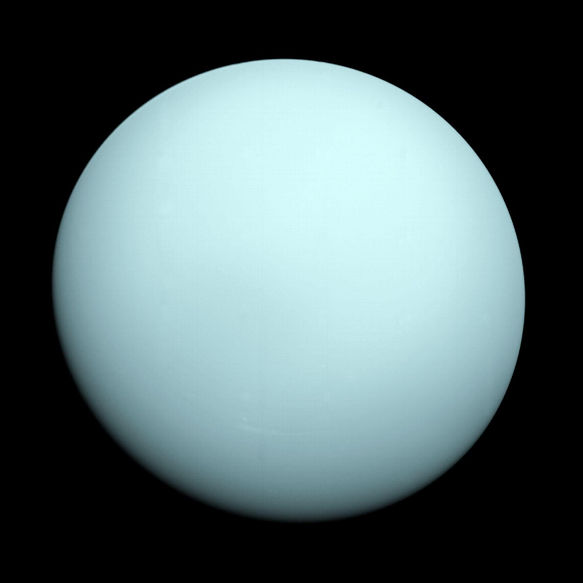
Uranus is made mostly of icy materials and gases, which is why scientists classify it as an ice giant rather than a gas giant like Jupiter or Saturn. Its interior is believed to contain large amounts of water, ammonia, and methane ices, surrounded by an outer layer of hydrogen and helium gas. The methane in Uranus’ upper atmosphere absorbs red light and reflects blue-green light, giving the planet its distinctive pale blue color.
Deep inside, Uranus may have a small rocky core made of silicate rock and metals, but most of the planet is made up of superheated, dense fluids rather than solid ground. This means Uranus has no true solid surface that a spacecraft—or a human—could land on, making it one of the most unusual worlds in our Solar System.
Why does Uranus spin on its side?
Uranus spins on its side because scientists believe it was struck by a massive object early in the Solar System’s history. This giant collision, possibly with a world two or three times the size of Earth, likely knocked Uranus over, leaving it tilted at about 98 degrees. As a result, Uranus rotates almost completely sideways compared to the other planets.
This extreme tilt makes Uranus one of the strangest planets in the Solar System. Instead of having normal seasons, each pole can face the Sun for about 42 years at a time, followed by decades of darkness. Its sideways spin creates unusual weather patterns, dramatic seasonal changes, and a magnetic field that is tilted and oddly offset from the planet’s center.
How cold is Uranus?
Uranus is the coldest planet in the Solar System, with atmospheric temperatures dropping to around −224° C or −371° F. That’s even colder than Neptune, despite Neptune being farther from the Sun. Scientists think Uranus is so cold because it gives off very little internal heat compared to the other giant planets.
Its upper atmosphere is made mostly of hydrogen, helium, and methane, creating freezing, high-pressure conditions with powerful winds and icy clouds. The extreme cold on Uranus makes it a fascinating world for scientists studying how ice giant planets form and evolve.
How many moons does Uranus have?
Uranus has 29 known moons, making it one of the most moon rich planets in our Solar System. Its five largest moons, Miranda, Ariel, Umbriel, Titania, and Oberon, are the best known and are fascinating worlds of ice and rock, with deep canyons, giant cliffs, and heavily cratered surfaces. Scientists think some of these moons may even have hidden subsurface oceans.
What makes Uranus’ moons especially unique is their names, most are named after characters from the works of William Shakespeare and Alexander Pope, giving Uranus what scientists sometimes call a “literary moon system.” As telescopes improve, astronomers may discover even more small moons orbiting this distant ice giant in the future.
Could life exist on Uranus?
Uranus is considered very unlikely to host life as we know it, because it is an extremely cold, high pressure ice giant with no solid surface and a harsh atmosphere made mostly of hydrogen, helium, and methane. Temperatures in its upper atmosphere can drop below −220° C or −364° F, and deep inside the planet, pressures become so intense that life similar to anything on Earth would struggle to survive.
However, scientists have not completely ruled out the possibility of simple microbial life in unusual environments, such as deep atmospheric layers where temperatures and pressures may be more moderate. Some of Uranus’ moons are also considered more promising places to search for life, especially if they contain hidden subsurface oceans beneath their icy crusts.

Join the Exo Solaria Union
Help aid in UAP research, Stay informed on the UAP phenomenon, and to help push the United States government for full disclosure regarding UAP and alien species.